

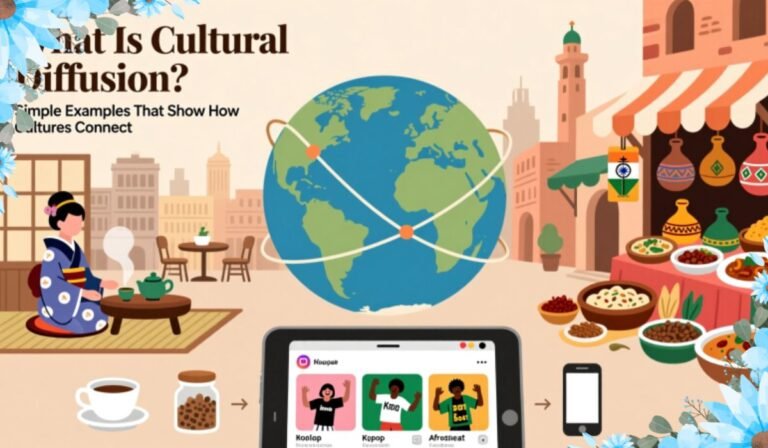
Introduction: Understanding How Cultures Connect
Culture is the heart of human life—it shapes how we think, speak, dress, eat, and celebrate. But cultures don’t exist in isolation. They constantly interact, exchange ideas, and influence one another in ways both visible and subtle. This ongoing exchange is known as Cultural Diffusion. It’s how sushi became popular in the United States, how jeans are worn in nearly every country, and how languages borrow words from one another.
At its core, Cultural Diffusion is about connection. It explains how ideas, beliefs, and customs move from one society to another, often transforming both in the process. In today’s globalized world—where a song from Korea can top charts in Europe or a food trend can start online and spread worldwide—understanding cultural diffusion helps us see just how interlinked our lives have become.
Quick Bio Information
Cultural Diffusion Definition – The spread of beliefs, ideas, and practices between cultures.
Origin Of The Concept – Studied by early sociologists like Alfred Kroeber and Ralph Linton.
Main Drivers – Trade, migration, technology, and communication.
Key Example – The global popularity of pizza, jeans, and the English language.
Five Types – Expansion, Contagious, Hierarchical, Stimulus, Relocation.
Modern Influence – Accelerated by social media and global connectivity.
Benefits – Promotes innovation, understanding, and global unity.
Challenges – Risk of cultural loss or appropriation.
Real-Life Impact – Seen in global cuisine, fashion, and entertainment.
Historical Roots – Traced through trade routes like the Silk Road.
Future Outlook – Expected to grow as digital globalization expands.
Why Cultural Diffusion Matters In Today’s World
Cultural diffusion matters more now than ever before. In an era defined by travel, migration, and instant digital communication, cultures influence one another at lightning speed. Every time people share recipes online, listen to foreign music, or adopt international fashion trends, they’re participating in cultural diffusion.
This process not only spreads creativity and innovation but also builds bridges of understanding between different societies. It allows people to appreciate new perspectives, learn from global traditions, and even find common ground in shared human experiences. From education to business, from art to technology, the effects of cultural diffusion shape our daily lives in ways we often take for granted.
However, diffusion also raises important questions—how much of a culture can change before it loses its original identity? How can societies share and borrow respectfully? Exploring these questions gives depth to our understanding of how interconnected humanity truly is.
Cultural Diffusion Definition In Sociology
In sociology, Cultural Diffusion refers to the process by which elements of culture—such as beliefs, practices, language, or technology—spread from one group to another. It’s a form of cultural change that can reshape entire societies over time.
Sociologists study this process to understand how ideas move across borders, how traditions evolve, and how social systems adapt. Cultural diffusion can occur through trade, war, migration, media, or even simple human curiosity. For example, the English language today is a product of centuries of diffusion, shaped by Latin, French, and Germanic influences.
The idea isn’t new—human history is filled with examples. Ancient trade routes like the Silk Road connected Asia, Africa, and Europe, carrying not just goods but art, religion, and philosophy. The spread of Buddhism from India to China, or the adoption of Arabic numerals in Europe, are all powerful examples of how cultural diffusion fuels human progress.
Simple Examples Of Cultural Diffusion In Everyday Life
Cultural diffusion is everywhere around us. You can see it, taste it, wear it, and hear it.
Food is one of the most visible examples. Italian pizza, Chinese noodles, and Mexican tacos are enjoyed around the world, often with local twists. Similarly, coffee—originating in Ethiopia—has become a universal beverage found in nearly every culture.
Fashion tells a similar story. Jeans, first created for American workers, are now a global wardrobe staple. Japanese kimonos inspire modern Western fashion, while African prints influence designers in Europe and America.
Music, too, crosses borders easily. Hip-hop, born in New York’s African American communities, has been embraced and reinterpreted by artists in France, Japan, and South Korea. K-pop, in turn, has captivated fans across continents. Each of these examples shows how cultures blend, creating new forms of expression that reflect our shared humanity.
The Main Types Of Cultural Diffusion Explained
There are several ways in which cultural diffusion takes place. Sociologists commonly divide them into five main types—Expansion, Contagious, Hierarchical, Stimulus, and Relocation Diffusion.
These types describe how ideas travel, how fast they spread, and how they change along the way. Expansion diffusion happens when ideas spread outward but remain strong at their origin. Contagious diffusion spreads like a wave through close contact. Hierarchical diffusion flows from people or places of influence. Stimulus diffusion involves adapting an idea to fit new circumstances, while relocation diffusion happens when people physically move and carry their culture with them.
Together, these categories help explain how everything from religion to fashion trends travels across the world and evolves over time.
Expansion Diffusion: How Ideas Spread And Stay Strong
Expansion Diffusion occurs when an idea spreads from one place to another but continues to thrive in its original home. This form of diffusion explains how languages, religions, and technologies expand beyond their starting points.
For instance, Christianity originated in the Middle East but spread throughout Europe and eventually across the world, while still remaining central to its birthplace. The English language, too, expanded globally through colonization, trade, and technology, becoming a major world language without disappearing from its roots.
Expansion diffusion is driven by communication, education, and cultural openness. It often happens naturally when societies interact through trade or media. What makes it unique is that instead of replacing the original culture, it adds to it—allowing ideas to multiply and diversify.
Contagious Diffusion: The Viral Spread Of Culture
Contagious Diffusion spreads through direct contact—much like a viral trend. It occurs quickly, usually within populations that are close together or connected through technology.
Think about how internet challenges, viral dances, or new slang spread rapidly across the globe. A TikTok trend that starts in one country can reach millions of people within hours. Historically, contagious diffusion also happened when new agricultural techniques, songs, or customs spread through communities living side by side.
This form of diffusion shows the power of human networks. Whether through face-to-face interaction or online sharing, contagious diffusion proves that ideas are contagious—and that connection is at the heart of cultural exchange.
Hierarchical Diffusion: When Influence Comes From The Top
Hierarchical Diffusion happens when ideas spread from influential people, institutions, or places of authority to others. It’s about influence and imitation.
For example, Queen Victoria’s white wedding dress in the 19th century inspired generations of brides worldwide to wear white. Today, celebrity fashion, viral tweets, and influencer marketing all follow this same principle—ideas flow from the top down.
Cities known for creativity or prestige—like Paris, New York, or Tokyo—often serve as diffusion centers where trends start before spreading globally. In the digital age, social media has made hierarchical diffusion even more powerful, turning online influencers into modern trendsetters whose choices shape global behavior.
Stimulus Diffusion: When Ideas Evolve Across Cultures
Stimulus Diffusion occurs when one culture adopts an idea from another but adapts it to suit its own needs. This is where creativity thrives.
For example, the mathematical concept of zero originated in ancient civilizations but was developed further in India and then adopted by the Islamic world and Europe. The game of chess, first created in India, evolved as it moved through Persia to Europe, where it became the version we know today.
In modern times, fusion cuisines, like Korean tacos or sushi burritos, show stimulus diffusion in action. Cultures borrow and transform ideas to create something entirely new. This kind of diffusion encourages innovation, blending traditions in ways that keep cultures dynamic and evolving.
Relocation Diffusion: How Migration Moves Culture
Relocation Diffusion occurs when people physically move from one place to another, bringing their customs, beliefs, and traditions with them. Unlike expansion diffusion, which spreads ideas outward, relocation shifts cultural centers to new places.
A clear example is how African slaves brought musical traditions to the Americas, influencing genres like blues and jazz. Similarly, when immigrants move to new countries, they introduce foods, languages, and festivals that enrich local culture.
This process reminds us that migration doesn’t just change the migrants—it changes the societies they join. Over time, relocation diffusion builds multicultural communities where diversity becomes part of everyday life.
How Cultural Diffusion Happens: The Mechanisms Behind The Process
Cultural diffusion occurs through several mechanisms. It can be direct, when cultures interact through trade, tourism, or personal relationships, or indirect, when ideas pass through a third culture before reaching another.
Technology and media now play major roles. Social media, movies, and global news instantly transmit cultural ideas around the world. Migration, education, and business partnerships also promote cross-cultural learning.
Sociologists describe this as part of acculturation—the process by which individuals or groups adopt traits from another culture while maintaining aspects of their own. Over time, these exchanges create a more connected, diverse global community.
The Positive And Negative Effects Of Cultural Diffusion
Cultural diffusion brings many benefits. It fosters creativity, diversity, and understanding. It allows societies to learn from one another, improving technology, cuisine, and art. It can even strengthen economies by encouraging global trade and tourism.
However, diffusion also has challenges. When dominant cultures spread their influence, smaller or indigenous cultures can lose their traditions. Cultural appropriation—adopting elements of another culture without respect or understanding—can cause harm. Balancing cultural sharing with preservation and respect is essential to ensure diffusion remains a positive force.
Conclusion: Why Understanding Cultural Diffusion Connects Us All
Cultural diffusion is one of the most powerful forces shaping our world. It tells the story of how humans learn, adapt, and grow through contact with others. From the clothes we wear to the languages we speak and the foods we love, it shows that every culture is part of a larger human tapestry.
In a world that’s becoming more connected every day, understanding cultural diffusion helps us appreciate both our differences and our shared creativity. It teaches us that cultural exchange isn’t just about borrowing—it’s about evolving together. When approached with respect and curiosity, diffusion can unite people, spark innovation, and celebrate what makes our global society beautifully diverse.
FAQs About Cultural Diffusion
What Is Cultural Diffusion In Simple Words?
Cultural diffusion is the process by which ideas, traditions, and customs spread from one culture to another, often through trade, travel, or communication.
Why Is Cultural Diffusion Important?
It promotes understanding, creativity, and global unity by allowing people to share and learn from each other’s cultures.
What Are The Main Types Of Cultural Diffusion?
The five main types are expansion, contagious, hierarchical, stimulus, and relocation diffusion. Each describes how ideas spread differently.
What Are Some Modern Examples Of Cultural Diffusion?
Examples include the worldwide popularity of sushi, K-pop, yoga, and social media trends that cross national boundaries.
How Does Technology Affect Cultural Diffusion?
Technology accelerates diffusion by connecting people instantly across the globe through social media, streaming platforms, and online learning.
Can Cultural Diffusion Be Negative?
Yes, it can lead to cultural appropriation or the loss of traditional practices if cultural elements are used without respect or understanding.
How Does Migration Influence Cultural Diffusion?
Migration spreads culture through relocation. When people move, they bring their languages, foods, and traditions, enriching their new communities.
People Also Read: Cold Culture In The USA Explained: The Truth Behind American Individualism
