

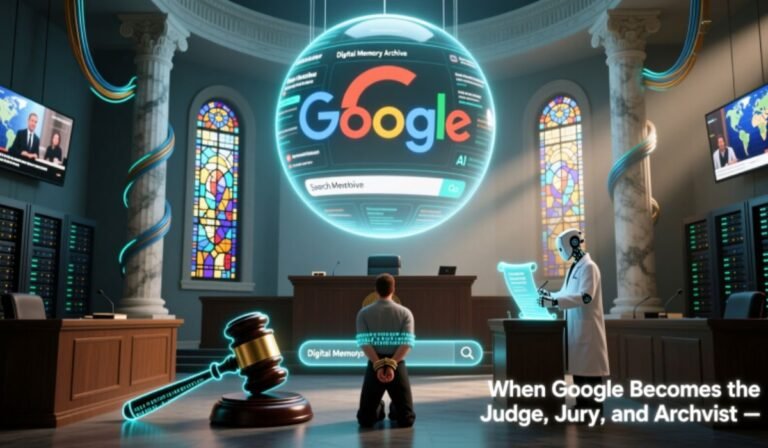
Type a name into Google, and a version of that person appears. Not a full picture — just whatever happens to rank first. Yet for employers, neighbors, institutions, and strangers, that snapshot becomes the truth. In a world where most decisions begin with a search, Google holds a role that no single institution has ever held before: it decides what we see, what we overlook, and what we quietly forget. Its results shape reputations, histories, and ultimately, public memory.
This isn’t simply a search engine. It is an authority that influences how society interprets reality.
The Judge: How Google Decides What Deserves to Be Seen
Google sorts and evaluates information at a scale no human system can match. It relies on machine-learning systems alongside a global workforce of reviewers to determine which pages appear at the top of search results. But rankings are not neutral. They reflect the biases of the data and the systems that interpret it.
Research has shown this clearly. Leadership searches tend to surface mostly men. Crime-related results skew toward certain communities. News rankings often emphasize widely circulated narratives rather than balanced perspectives. Once a pattern takes shape, search reinforces it by continually elevating the same types of sources.
The outcome isn’t intentional manipulation — it’s systemic inertia. What has historically been visible remains visible. What has not rarely surfaced. Search doesn’t only reflect the world; it reinforces it.
Fact-Checking and the Illusion of Neutrality
To address misinformation, Google incorporates fact-check labeling, source context panels, and credibility rankings. These measures do reduce the spread of outright falsehoods. But they also introduce a new dynamic: the platform effectively signals what counts as reliable knowledge.
Fact-checking requires judgment — and judgment is not objective. Claims change over time. Context shifts. A headline can simplify a complex topic to the point of distortion. And when one platform decides which sources are elevated as authoritative, it shapes not only what people learn, but what they believe is safe to say.
Neutrality becomes less about accuracy and more about alignment with accepted narratives.
The Jury: Enforcement, Penalties, and Silent Consequences
Google rarely needs to remove content to limit its influence. Visibility can be reduced quietly — sometimes without notification and without a clear path to appeal. Shadowbans, reduced reach, and demonetization have become common forms of enforcement. These actions can dramatically alter public presence, business viability, or personal credibility, even when no rules were knowingly violated.
For individuals and creators, the effect is simple: fewer people see what they publish. Momentum drops. Engagement falls. Search authority erodes. And because the process is often automated, transparency is limited. The consequences feel judicial, but the reasoning is often inaccessible.
Enforcement is not only a matter of policy; it is a matter of power.
The Archivist: What Stays Online and What Refuses to Fade
Google stores far more than search queries. It stores patterns of behavior, location trails, identity signals, and old versions of pages long after they are deleted. Cached pages, secondary mirror sites, and data broker networks ensure that once information becomes searchable, it is difficult to remove entirely.
In Europe, the “right to be forgotten” allows individuals to request the removal of outdated or irrelevant results. But in the United States, First Amendment protections prioritize publication over personal repair. As a result, a single event from years ago can define someone’s identity indefinitely, even after circumstances change.
The internet remembers differently than people do. It lacks context, evolution, and forgiveness.
When Search Becomes the Story
This is where reputation becomes vulnerable. A past mistake, a dismissed charge, an outdated article, or an anonymous allegation can overshadow years of growth or change. Search results determine whether someone is seen as employable, trustworthy, safe, credible, or not. The stakes are deeply personal.
This is the environment where reputation management exists — not as spin, but as correction. NetReputation works in this space daily, helping individuals address old, misleading, or disproportionate search results. Not to erase history, but to restore balance when search no longer reflects reality. Their work underscores something the search system does not account for: people change, and their stories change with them.
Search isn’t designed to show who someone is now — only what is most indexed.
The Larger Question
Google was built to organize information. But it now plays a central role in defining public identity. It shapes the narratives attached to individuals, organizations, and events — sometimes permanently.
The issue is not whether Google should exist or whether search should be regulated. The problem is whether any single system should have the unchecked authority to determine what is remembered and what is not.
We are living in the first era where memory is automated and permanence is effortless. The challenge is building systems that allow for revision, growth, and human context in a world optimized for categorization and speed.
Because no search result tells a whole story.
And reality has always been more complicated than what fits on page one.
