

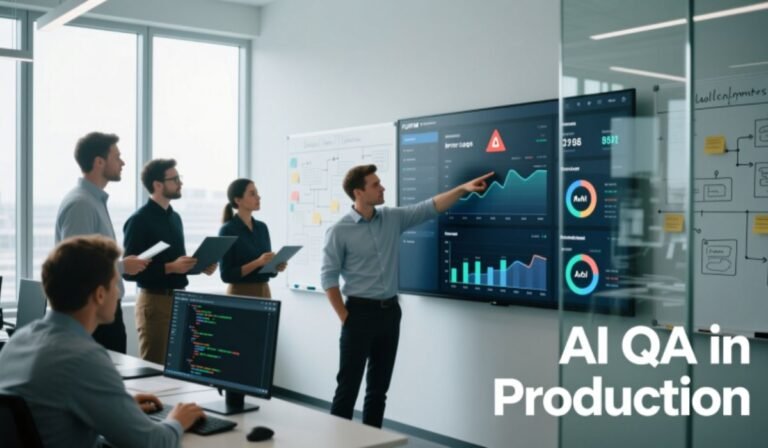
Artificial Intelligence has made its place in quality checks on production lines. It is fast, tireless, and sharp. It watches every product without breaks or distractions. Many companies now use an AI QA Agent to check if their products are built correctly. AI catches tiny flaws that humans often miss. But what happens when AI itself misses something big?
Why AI Is Used for Quality Checks?
In the past, most companies relied on human eyes to check for defects. Quality checkers would spot dents, scratches, missing parts, or incorrect assemblies. They followed paper checklists and visual guides. This method had benefits, but also limitations:
- People get tired and miss things.
- Not all quality checkers inspect in the same way.
- The process is slow, especially for large volumes.
- Mistakes are often found too late.
An AI QA Agent changes this. Machines do not get tired and can inspect every product closely. Computer vision systems use cameras and sensors to detect even the smallest errors. Machine learning models can be trained to understand what a perfect product looks like and flag anomalies. For many companies, this approach helps catch errors earlier, work faster, reduce waste, and achieve more consistent results.
It also aids production team members by providing step-by-step guidance and real-time validation. New operators can learn faster and make fewer mistakes. AI reduces the time it takes to ensure safety rules are followed, and when paired with tools like ChatGPT test automation, it can even help simulate quality checks before production starts.
What Can Go Wrong With AI Checks?
AI systems depend on training data. If it is incomplete or lacks variety, the AI may not catch certain errors. Confident decisions can be made without knowing if they are wrong, and removing human checks entirely can let mistakes go unnoticed.
Mistakes can happen when:
- The AI QA Agent does not recognize new or rare defects.
- Human review is removed too soon.
- Models are not updated to match minor production changes.
- No warning is given when AI is uncertain.
Even small changes in angles, shapes, or colors can confuse AI. If it hasn’t seen the new pattern before, it might wrongly approve or reject products. Once a system starts missing important signs, trust erodes, and correcting issues becomes expensive and time-consuming.
Risks of Trusting AI Without Backup
AI is often trusted to operate independently, but no system is flawless. Overreliance increases risks:
- Errors not seen before may be missed.
- No human might notice overlooked defects.
- AI may appear overly confident, approving defective parts.
Correcting these errors post-release can require recalls, rechecks, and risk damaging brand trust. Maintaining a balance between AI and human oversight is crucial.
How AI Can Be Made Safer in QA?
This isn’t about whether AI is good or bad, but about usage. When applied correctly, an AI QA Agent can enhance workflows. Companies can take steps like:
- Humans reviewing samples and edge cases, even with AI running checks.
- Training AI on all defect types, including rare ones.
- Sending uncertain cases for human review rather than automatic approval.
- Updating AI with new production data regularly.
- Using AI to support operators instead of replacing them entirely.
- Logging inspections with video or photo evidence to track errors.
- Testing AI systems regularly to ensure proper functioning.
- Encouraging operators to provide feedback to improve AI decisions.
What Can Engineers and Operators Learn?
From such situations, both engineers and operators can take away important lessons.
For engineers:
- Do not trust AI without backup systems.
- Watch for changes in the production process that might create new types of flaws.
- Test the system regularly with new data.
- Keep logs of what the AI approves and rejects.
- Build ways to collect feedback from machine operators.
- Compare AI decisions against actual results to find gaps in training.
- Work with teams to train AI using feedback from the shop floor.
For production operators:
- Report anything that looks off, even if the AI says it is fine.
- Ask questions when defects repeat.
- Help collect new samples of defects for AI training.
- Pay attention to AI alerts and use them to improve skills.
- Share examples where AI gave wrong answers.
- Understand that their role in spotting mistakes is still important.
When both engineers and operators work together, it becomes easier to keep the process safe and smooth. AI can be a helpful tool, but the people around it make it better.
How AI Can Still Help QA Work Better?
Even imperfect AI brings value when applied thoughtfully. It speeds inspections, spots flaws early, and reduces repetitive strain. Tools like LambdaTest KaneAI combine AI QA Agent capabilities with ChatGPT test automation to orchestrate tests across thousands of browser and device combinations, reducing the need for physical labs.
LambdaTestKaneAI is a GenAI-native testing agent that allows teams to plan, author, and evolve tests using natural language. It is built from the ground up for high-speed quality engineering teams and integrates seamlessly with the rest of LambdaTest’s offerings around test planning, execution, orchestration, and analysis.
KaneAI Key Features
- Intelligent Test Generation: Effortless test creation and evolution through Natural Language (NLP) based instructions.
- Intelligent Test Planner: Automatically generate and automate test steps using high-level objectives.
- Multi-Language Code Export: Convert your automated tests into all major languages and frameworks.
- Sophisticated Testing Capabilities: Express complex conditionals and assertions in natural language.
- API Testing Support: Effortlessly test backends and achieve comprehensive coverage alongside UI tests.
- Increased Device Coverage: Execute your generated tests across 3000+ browsers, OS, and device combinations.
AI improves QA workflows by:
- Performing faster checks on hundreds of parts per minute.
- Spotting errors early to prevent downstream issues.
- Maintaining better records via video/photo logs.
- Reducing routine workload for QA teams.
- Ensuring standard processes are followed consistently.
AI also provides engineers with real-time insights into production performance, highlighting areas for improvement.
Why Data Quality Matters?
If the training data is not good, the AI model will not work well. Weak or limited data leads to poor results.
To get better results:
- Use past production data to learn from real mistakes.
- Include all defect types, even rare ones.
- Use data from different times, teams, and machines.
- Remove unclear or duplicate samples from the training set.
Clean, well-structured records, including photos, videos, and process logs, allow AI to learn effectively. This also enhances tools like ChatGPT test automation, making simulated QA scenarios more accurate.
Building Trust in AI Tools
AI does not make decisions the same way people do. It uses data and pattern recognition. To build trust, teams need to:
- Explain how the AI system works in simple terms.
- Be open about the limits of AI checks.
- Share clear reasons for AI decisions when possible.
- Mix machine feedback with human review for the best results.
- Create shared rules for when to accept or reject AI results.
Final Thoughts
AI can assist in quality checks, but must be supported. Mistakes happen when training or oversight is inadequate. Quality work requires a combination of training, testing, and teamwork between humans and machines. Slowly integrating AI, starting with supportive roles, allows companies to develop a reliable AI QA Agent without replacing human judgment. Clear rules, regular testing, and feedback loops ensure products remain safe, consistent, and high-quality.
