

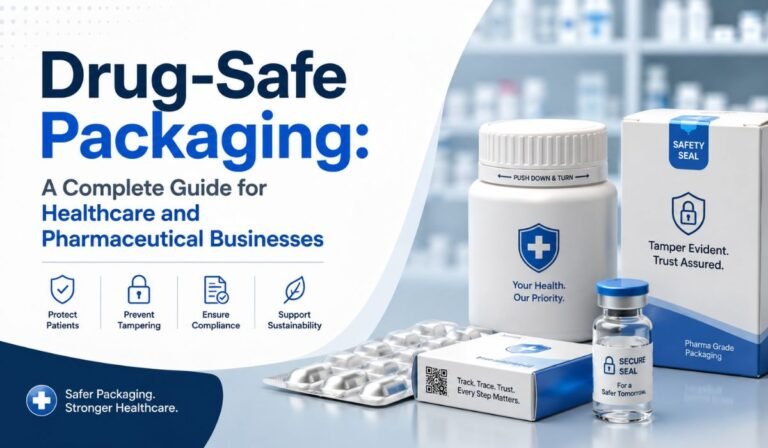
Packaging might seem like the last step in your process, but it’s doing some of the heaviest lifting in the whole pharmaceutical supply chain. The bottle, blister or vial you choose decides whether a medicine reaches a patient potent, sterile and safe, or arrives degraded and useless. Get it right and you protect patients, your licence and your reputation. Get it wrong and you’re looking at recalls, regulatory headaches and serious liability.
This guide walks you through everything you need to know about drug-safe packaging, from core requirements and compliance standards to why amber glass bottles and high-quality glass packaging keep earning their place in healthcare. You’ll learn how to match packaging to product type, what to ask suppliers, and which trends are reshaping the industry. Let’s get into it.
What Is Drug-Safe Packaging?
Definition and Purpose
Drug-safe packaging is any packaging system designed to protect a medicinal or healthcare product throughout its entire lifecycle, from the manufacturing line to the moment a patient takes a dose. It’s not just a container. It’s a barrier, a stabiliser and a safety mechanism rolled into one.
Good pharmaceutical packaging does three jobs exceptionally well:
- Protects products from contamination – keeping out microbes, dust, moisture and anything else that could compromise quality.
- Maintains stability and potency – shielding active ingredients from light, oxygen and humidity so the medicine works exactly as intended.
- Supports safe transportation and storage – surviving the bumps, temperature swings and handling of a long supply chain without failing.
In short, the packaging is part of the product. When it fails, the medicine fails too.
Why It Matters in Healthcare
Why does this deserve your full attention? Because the stakes in healthcare are uniquely high.
- Patient safety comes first. Compromised packaging can expose patients to contaminated, degraded or incorrectly dosed medication.
- Regulatory obligations are non-negotiable. Bodies like the MHRA expect packaging to meet strict standards, and falling short can halt your product entirely.
- Recall and liability risks are expensive and damaging. A single packaging failure can trigger costly recalls, legal action and lasting reputational harm.
- Supply chain integrity depends on packaging that performs across every link, from warehouse to pharmacy shelf.
Here’s the takeaway: in pharmaceuticals, packaging isn’t a cost to minimise. It’s an investment in safety, compliance and trust.
Key Requirements of Pharmaceutical Packaging
Not all packaging is built for medicine. To qualify as drug-safe, it needs to tick several important boxes.
Product Protection
The first job of any pharmaceutical packaging is to defend the product against its environment. That means:
- Moisture resistance – humidity degrades many active ingredients and can ruin tablets and powders.
- Light protection – UV and visible light break down sensitive compounds, reducing potency.
- Oxygen barrier properties – oxygen accelerates oxidation, shortening shelf life.
- Chemical compatibility – the packaging material must never react with the medicine inside it.
If any one of these fails, product integrity is at risk before the medicine even leaves your facility.
Regulatory Compliance
UK businesses operate under a clear and demanding regulatory framework. Your packaging strategy needs to align with:
- UK pharmaceutical regulations governing how medicines are produced, labelled and packaged.
- GMP (Good Manufacturing Practice) requirements, which set the standard for consistent, controlled production.
- MHRA expectations, including documentation, testing and quality assurance.
- Labelling and traceability standards, ensuring every product can be identified and tracked.
Compliance isn’t a box-ticking exercise. It’s the foundation that keeps your products legal and your patients protected.
Tamper-Evident Features
Patients and pharmacists need to trust that a product hasn’t been interfered with. Tamper-evident packaging makes that obvious at a glance. Look for:
- Security seals that clearly show if a container has been opened.
- Closure systems designed to resist and reveal tampering.
- Counterfeit prevention measures such as unique markings and serialisation.
A strong tamper-evident design protects patients and shields your brand from the growing threat of falsified medicines.
Why Glass Packaging Remains a Trusted Choice
Plastics have their place, but when it comes to protecting medicines, glass packaging still sets the benchmark. There’s a reason it’s been trusted for generations.
Benefits of Glass Packaging for Pharmaceuticals
- Chemically inert – glass doesn’t react with the contents, even with potent or sensitive formulations.
- Non-reactive with medicines – no leaching, no contamination, no unwanted chemical interactions.
- Excellent barrier protection – glass blocks moisture, gases and odours far better than most alternatives.
- Premium and sustainable appearance – it looks the part, signalling quality to customers and clinicians alike.
For products where purity is paramount, glass simply does the job better.
Environmental Advantages
Glass also earns points for sustainability, which matters more to buyers and regulators every year:
- Recyclability – glass can be recycled endlessly without losing quality.
- Reusability potential – many glass formats can be cleaned and reused.
- Reduced material degradation over time – glass doesn’t break down or shed microplastics into the environment.
Choosing glass isn’t just good for the medicine. It’s good for your sustainability credentials too.
Comparison with Plastic Alternatives
So how does glass really stack up against plastic? Here’s a side-by-side look at the factors that matter most.
| Factor | Glass Packaging | Plastic Packaging |
| Chemical resistance | Excellent – chemically inert and non-reactive | Variable – risk of leaching and interaction |
| Sustainability | Endlessly recyclable, no microplastics | Recyclable but often degrades, sheds microplastics |
| Product compatibility | Suitable for almost all formulations | Limited with sensitive or aggressive compounds |
| Shelf-life protection | Superior barrier against light, moisture, oxygen | Moderate, can allow gas permeation over time |
| Consumer perception | Premium, trusted, high-quality feel | Functional, but often seen as lower value |
The verdict? For high-value, sensitive or premium products, glass is hard to beat.
The Importance of Amber Glass Bottles in Medicine Storage
If clear glass is good, amber glass bottles are exceptional for light-sensitive products. They’re a staple of pharmaceutical packaging for one very good reason: they block what damages medicines most.
How Amber Glass Bottles Protect Sensitive Products
- UV light filtration – the amber tint absorbs harmful ultraviolet and blue light before it can reach the contents.
- Reduced degradation of active ingredients – less light exposure means slower breakdown of sensitive compounds.
- Extended shelf life – better protection translates directly into longer, more reliable product stability.
For anything that reacts to light, amber glass is your first line of defence.
Common Pharmaceutical Applications
Amber glass bottles show up across a huge range of healthcare products, including:
- Liquid medicines that need protection from light and contamination.
- Tinctures with delicate botanical and alcohol-based formulations.
- Essential oils prone to degrading in sunlight.
- Nutraceutical supplements where potency and shelf life are key selling points.
- Laboratory reagents requiring stable, non-reactive storage.
If your product is sensitive, there’s a good chance amber glass belongs in your packaging mix.
Choosing the Right Amber Glass Bottles
Picking the right bottle is about more than colour. Consider these factors:
- Bottle sizes – match capacity to dosing requirements and product volume to avoid waste and excess headspace.
- Neck finishes – ensure the finish suits your chosen closure for a secure, leak-proof fit.
- Closure compatibility – child-resistant, dropper, or tamper-evident caps all need the right neck design.
- Regulatory considerations – confirm the glass type and grade meet relevant pharmacopoeia and MHRA expectations.
Get these details right and you’ll have medicine storage containers that protect, comply and perform.
Packaging Considerations for Different Pharmaceutical Products
Different products have different needs. A one-size-fits-all approach simply won’t cut it. Here’s how to tailor your packaging by product type.
Tablets and Capsules
Solid dose forms are vulnerable to moisture and need clear safety features. Prioritise:
- Moisture protection to keep tablets stable and effective.
- Child-resistant closures to prevent accidental ingestion.
- Tamper-evident seals to confirm product integrity.
Liquid Medicines
Liquids bring their own challenges, from spills to dosing accuracy. Focus on:
- Leak prevention through secure closures and reliable neck finishes.
- Light protection, where amber glass bottles really earn their keep.
- Accurate dosing support via integrated droppers, measuring caps or graduated markings.
Sterile Products
Sterile products demand the highest level of control. Requirements include:
- Sterility maintenance throughout storage and use.
- Contamination prevention with robust, validated barrier systems.
- Specialised closure systems designed for sterile packaging, such as vial seals and crimp caps.
Match the packaging to the product, and you remove a huge amount of risk before it ever appears.
Compliance and Quality Standards to Consider
Pharmaceutical compliance is where good intentions meet hard evidence. You need to prove your packaging is fit for purpose, not just claim it.
UK and International Standards
Your packaging should align with recognised standards, including:
- MHRA requirements for medicines sold in the UK.
- GMP guidelines governing consistent, controlled manufacturing.
- ISO quality standards that demonstrate robust quality management.
Documentation and Testing
Standards mean little without proof. Make sure you have:
- Material compatibility testing showing the packaging won’t react with the product.
- Stability studies confirming shelf life and performance over time.
- Quality assurance procedures that document every step of the process.
Strong documentation is your safety net during audits and inspections.
Supplier Qualification
Your packaging is only as reliable as the supplier behind it. Before committing, assess:
- Manufacturing standards and whether they meet pharmaceutical-grade requirements.
- Traceability systems that track materials from source to delivery.
- Quality certifications that back up their claims with evidence.
A qualified supplier becomes a genuine partner in your compliance, not just a vendor.
Emerging Trends in Pharmaceutical Packaging
Packaging never stands still. Staying ahead of these trends keeps you competitive and compliant.
Sustainable Packaging Solutions
Sustainability is moving from nice-to-have to expected. We’re seeing:
- Increased use of recyclable glass packaging as brands cut their environmental footprint.
- Circular economy initiatives that prioritise reuse, recycling and reduced waste.
Smart Packaging Technologies
Technology is making packaging smarter and safer. Watch for:
- QR codes that connect patients to dosing information and authenticity checks.
- Track-and-trace systems that strengthen the pharmaceutical supply chain.
- Digital authentication that fights counterfeiting in real time.
Patient-Centric Design
Finally, packaging is becoming more focused on the people using it. That means:
- Easy-open closures that balance accessibility with child safety.
- Improved accessibility for elderly and less able patients.
- Clearer labelling that reduces confusion and dosing errors.
The future of healthcare packaging solutions is sustainable, connected and built around the patient.
How to Choose the Right Drug-Safe Packaging Partner
The right supplier makes everything easier. The wrong one creates risk you can’t afford. So how do you tell them apart?
Questions to Ask Suppliers
Before signing anything, get straight answers to these:
- What compliance certifications do you hold? Look for GMP, ISO and relevant pharmaceutical accreditations.
- Can you provide testing documentation? Material compatibility and stability data should be readily available.
- What customisation options are available? From bottle sizes to closures and labelling, flexibility matters.
Evaluating Long-Term Value
Cheap packaging that fails is the most expensive option of all. Weigh the bigger picture:
- Quality consistency across every batch and order.
- Regulatory expertise that keeps you ahead of changing requirements.
- Supply reliability so you’re never left scrambling for stock.
- Sustainability commitments that align with your brand and your customers’ expectations.
Choose a partner, not just a price. It pays off every single time.
Conclusion
Drug-safe packaging is far more than a container. It’s a frontline defender of patient safety, product integrity and regulatory compliance across the entire pharmaceutical supply chain. From moisture and light protection to tamper-evident features and rigorous testing, every detail counts.
Here’s your quick recap:
- Drug-safe packaging protects medicines from contamination, degradation and tampering.
- Glass packaging offers unmatched chemical resistance, barrier protection and sustainability.
- Amber glass bottles excel at shielding light-sensitive products and extending shelf life.
- Compliance with MHRA, GMP and ISO standards is essential, backed by solid documentation.
- The right packaging partner delivers quality, reliability and regulatory confidence.
Now’s the perfect time to take a hard look at your current packaging strategy. Are your products as well protected as they could be? Are you meeting every compliance requirement with room to spare? If there’s any doubt, partner with an experienced pharmaceutical packaging supplier who can help you protect your products, your patients and your reputation, from production line to patient’s hands.
